


This article was published on Arbona Health Hub Volume 1 Issue 1 (ISSN: 3065-5544).
During our studies of the head and neck, a notable topic discussed was ankyloglossia. While we defined ankyloglossia through its clinical presentation, our discussion did not encompass its etiology, incidence/prevalence, signs and symptoms, long-term effects, or treatment options.

In class, Ankyloglossia was defined as a condition characterized by the extension of the frenulum of the tongue to the tip, impeding its protrusion. Nonetheless, upon extensive searches on the condition, it seems as though achieving consensus on aspects pertinent to this congenital anomaly remains an ongoing endeavor. Ankyloglossia, or tongue-tie, is currently defined by the International Affiliation of Tongue-Tie Professionals organization as restricted tongue mobility stemming from a constrictive lingual frenulum. Specifically, the frenulum, or “tissue remnant,” is located on the midline between the tongue’s ventral surface and the mouth’s floor. The condition may result in many symptoms, varying in severity.
Findings
The above-mentioned discord regarding Ankyloglossia’s definition stems from the noticeable need for agreement regarding the classification system and accepted diagnostic parameters for the condition. The diagnostic process often relies on various grading tools, albeit vague in their application. Among diagnostic tests, the Coryllos classification is employed to categorize the type of frenulum. Nonetheless, the method overlooks the crucial evaluation of tongue function as a diagnostic parameter. In contrast, the Hazelbaker Assessment Tool for Lingual Frenulum Function (HATLFF) provides a more comprehensive and complete inspection by examining both the tongue anatomy and the tongue function. This tool works through a point system, in which 10 points are assigned for frenulum anatomy and 14 points are allotted for tongue function. The scores obtained from this assessment then guide recommendations for surgical intervention. For instance, surgery is not deemed necessary if a function score reaches 14, irrespective of the anatomy score, whereas intervention is usually advised if the anatomy score falls below 8.

The plausible causes of Ankyloglossia remain unknown. While some studies have implied a potential link between Ankyloglossia and syndromes such as X-linked cleft palate syndrome, Kindler syndrome, Optiz syndrome, and Van der Woude syndrome, these occurrences are uncommon, and Ankyloglossia usually presents in individuals without any congenital pathologies or diseases. On the contrary, some studies support the idea that the condition may be inherited genetically, while others hypothesize potential risk factors, such as newborns born to mothers who use cocaine.
The lack of agreement on standardized diagnostic criteria and evaluation tools leaves the incidence and epidemiology of this congenital disorder vague. While the disease is more common in males, there is no bias based on race. Incidence rates vary widely, ranging from as low as 0.1% to as high as 10.7%, with significant increases in recent years, possibly due to the broad definition of the condition. Specialists suggest that Ankyloglossia might be overdiagnosed in our society, potentially leading to unnecessary surgical procedures. Other factors that may contribute to the increased diagnoses in children include increased awareness of the condition, heightened focus on breastfeeding, its benefits, and the impact of Ankyloglossia on the processes and growth in medical practitioners detecting and treating the condition.
Symptoms primarily revolve around the limitations imposed by restricted tongue mobility. The condition can present itself during breastfeeding, marked by difficulties such as ineffective latching and persistent latch loss, both of which may ultimately result in inadequate weight gain and failure to thrive. For mothers, symptoms include discomfort and pain during breastfeeding, insufficient milk production, and incomplete emptying due to defective suckling. This can lead to an array of issues, including nipple infections, ulceration, and bleeding, which may prompt early cessation of breastfeeding, exacerbating the feeding difficulties, poor weight gain, and failure to thrive in the infant. Later in development, the disease hinders the pronunciation of consonants and specific sounds and mechanically impedes various actions such as lip licking, kissing, and performing tongue tricks.
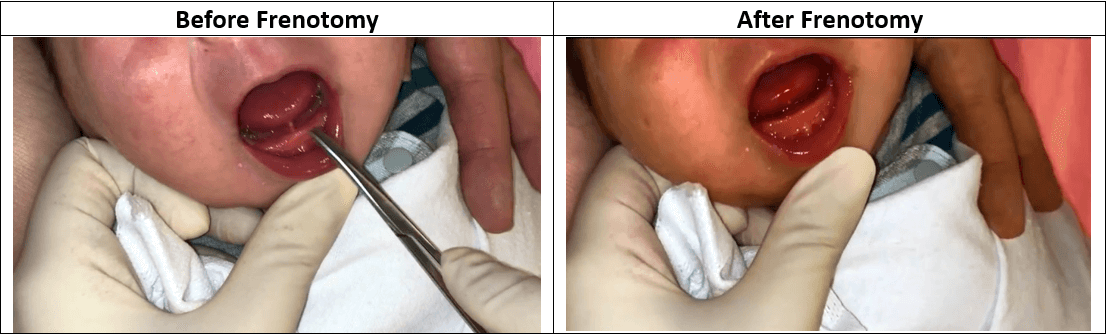
The absence of conclusive diagnostic and management criteria for the disease leads to disputes about optimal intervention for its treatment if deemed necessary. The most common procedure, frenotomy, is an incision of the lingual frenulum to release the tongue and allow mobility. The procedure is typically recommended for patients with outstanding HATLFF scores or who have not responded to alternative non-invasive treatments; prompt intervention is recommended to mitigate potential breastfeeding difficulties.

Ethical concerns have been raised regarding the invasive nature of the surgery, particularly as it has not been associated with any beneficial outcomes beyond encouraging continued breastfeeding. As such, specialists endorse an initial evaluation by lactation consultants for those presenting with breastfeeding problems to assess for any potential underlying causes, such as airway obstruction, laryngopharyngeal reflux, and craniofacial anomalies, including abnormal palatal, mandibular, or maxillary maturation. Maternal facets should also be looked into, including nipple anatomy, position and/or support of the breast, milk supply, and breast infection. Also, surgery is contraindicated in infants with neuromuscular disorders, hypotonia, retrognathia, coagulopathies, and micrognathia. Still, these contraindications are sometimes dismissed due to the procedure’s perceived low risk. Complications are uncommon.
Conclusion
Ankyloglossia presents challenges due to its unclear definition and diagnostic criteria. Causes remain undetermined, with controversies over its association with specific syndromes and genetic inheritance. Diagnosis is challenging due to the lack of standardized tools and possible overdiagnosis. Symptoms vary from breastfeeding difficulties in infants to speech impediments and motor constraints later in life. Treatment often involves surgical intervention, but ethical concerns persist due to limited evidence of its benefits beyond aiding breastfeeding. A comprehensive evaluation by specialists is recommended to identify alternate underlying issues.
References
Becker S, Brizuela M, Mendez MD. Ankyloglossia (Tongue-Tie) [Updated 2023 Jun 9]. In: StatPearls [Internet]. Treasure Island (FL): StatPearls Publishing; 2024 Jan-. Available from: https://www.ncbi.nlm.nih.gov/books/NBK482295/
Becker, S., Brizuela, M., & Mendez, M. D. (2023). Ankyloglossia (Tongue-Tie). In StatPearls. StatPearls Publishing.
Brzęcka, D., Garbacz, M., Micał, M., Zych, B., & Lewandowski, B. (2019). Diagnosis, classification and management of ankyloglossia including its influence on breastfeeding. Developmental period medicine, 23(1), 79–87.
https://doi.org/10.34763/devperiodmed.20192301.7985
González Garrido, M. D. P., Garcia-Munoz, C., Rodríguez-Huguet, M., Martin-Vega, F. J., Gonzalez-Medina, G., & Vinolo-Gil, M. J. (2022). Effectiveness of Myofunctional Therapy in Ankyloglossia: A Systematic Review. International journal of environmental research and public health, 19(19), 12347.
https://www.mdpi.com/1660-4601/19/19/12347
Messner, A.H., Walsh, J., Rosenfeld, R.M., Schwartz, S.R., Ishman, S.L., Baldassari, C., Brietzke, S.E., Darrow, D.H., Goldstein, N., Levi, J., Meyer, A.K., Parikh, S., Simons, J.P., Wohl, D.L., Lambie, E. and Satterfield, L. (2020), Clinical Consensus Statement: Ankyloglossia in Children. Otolaryngology–Head and Neck Surgery, 162: 597-611. https://doi.org/10.1177/0194599820915457 (https://doi.org/10.1177/0194599820915457).
Figure 1. https://kidscorner.ca/wp-content/uploads/2023/09/kids-corner-blog-12.jpg

Figure 2. https://oss.jocpd.com/files/article/20221116-1629/pdf/46-6%287%29.pdf
Figure 3. https://dentagama.com/img/031020073041Frenotomy.png
[…] N. Soto Rodriguez breaks down ankyloglossia, its symptoms, and treatment (p. […]