



This article was published on Arbona Health Hub Volume 1 Issue 1 (ISSN: 3065-5544).
The menstrual cycle usually occurs over a 28-day period but can range anywhere from 21 to 35 days, although this might be different for everyone, and it consists of four phases: menstrual, follicular, ovulation, and luteal. During these phases, the body undergoes hormonal fluctuations specifically for reproductive hormones such as estrogen/estradiol (E2), luteinizing hormone (LH), follicle-stimulating hormone (FSH), and progesterone (P4).
- Estrogen stimulates growth of cells that line the uterus.
- Progesterone maintains the cells that line the uterus.
- Follicle-stimulating hormone stimulates growth, and maturation of follicles in the ovaries.
- Luteinizing hormone stimulates eggs to be released from the ovary.

The menstrual phase is the first stage of your menstrual cycle, it is also when you get your period. Therefore, your hormone levels of estrogen and progesterone decrease causing the thickened lining of your uterus to shed in a combination of blood, mucus, and tissue.
The follicular phase is the longest phase of the cycle, and it overlaps with your menstrual phase since it starts on the first day of your period and ends when you start to ovulate. In this phase, the pituitary gland in the brain releases follicle-stimulating hormone that stimulates your ovaries to produce follicles (eggs). Eventually, one of these follicles will mature and become dominant while others will be destroyed or reabsorbed by your body. Once that’s done your follicle-stimulating hormone levels decrease while your estrogen levels start to increase making the lining of your uterus grow and thicken.
The ovulation phase starts with the release of luteinizing hormone, it’s the phase where ovulation takes place. Therefore, the ovary releases a mature egg that will travel through the fallopian tube toward the uterus. If fertilization occurs the egg travels to the uterus.
The luteal phase is the phase after ovulation and before the menstrual phase. In this phase, the follicle that contained the egg in ovulation turns into the corpus luteum. The corpus luteum produces progesterone along with some estrogen which helps thicken the lining of the uterus for possible egg fertilization. If the egg is not fertilized (no pregnancy occurs) then you’ll pass on to the menstrual phase.
Reproductive hormones during the cycle can influence our moods, energy levels, body temperature, and sleep, among many other factors.
Menstrual cycle effects on sleep
Getting enough sleep is essential for our physical and mental health. Our body requires sleep for every process, including maintenance, repair, and development, which are crucial for learning, memory, and overall health. Any disruptions in our sleep can interfere with our daily functioning, overall well-being, and cognitive function, and can even increase the risk of developing diseases such as Alzheimer’s and dementia. Therefore, it is crucial to maintain a consistent sleep schedule and prioritize quality sleep.
Numerous studies have found that women and men have different sleep patterns from an early age, where women tend to report poorer sleep quality and are at a higher risk for various sleep disorders such as insomnia and sleep apnea. During the menstrual cycle, women experience subtle changes in sleep quality throughout their reproductive years. The menstrual cycle has been associated with changes in circadian rhythms and sleep architecture, while sleep efficiency appears to remain constant and tends to decline in later reproductive age.
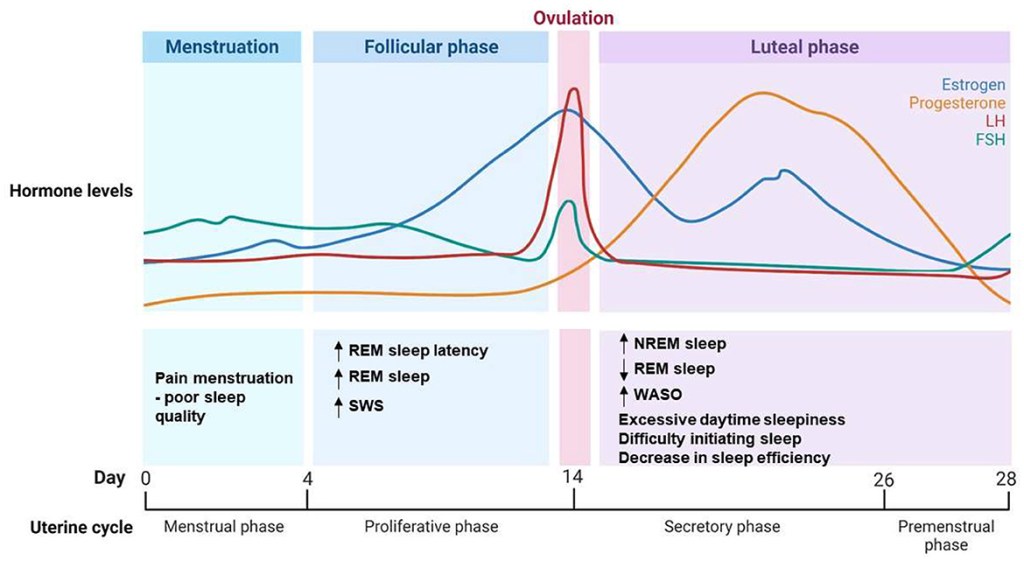
In the menstrual cycle, women have reported poorer sleep quality and more disturbances during the premenstrual week, even without significant menstrual-related complaints. Sleep studies have shown that this may be due to an increase in progesterone, and estrogen levels during the luteal phase, which might also be related to a rise in body temperature during this phase as well. Sleep disturbances can also depend on the regularity of your cycle since women with irregular cycles report more sleep difficulties than regular cycling women.
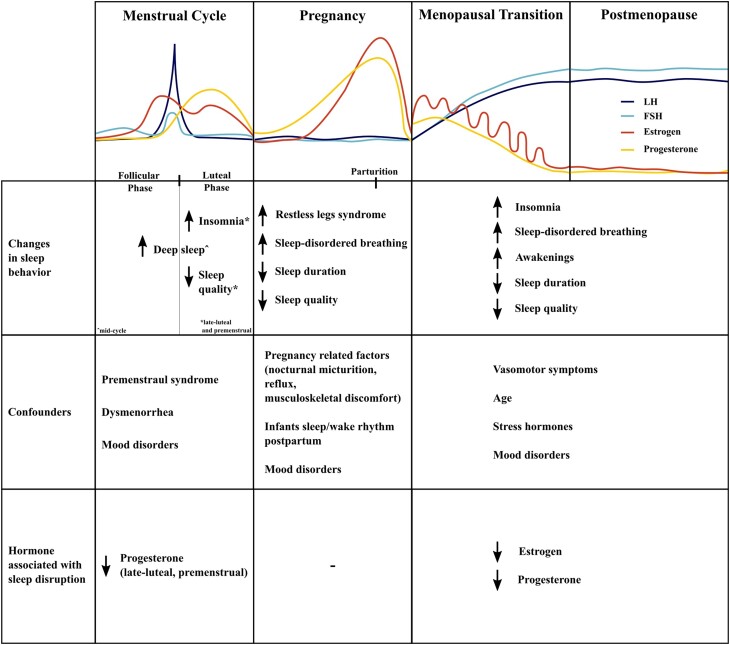
Haufe et al. JES 2023
Sleep disturbances don’t end in the reproductive years, they also affect peri and post-menopausal women. The hormonal changes that women experience during menopause are marked by a gradual decrease in the levels of estrogen and progesterone in their body. These fluctuations are associated with multiple sleep disturbances, including insomnia and increased awakenings. Additionally, menopausal women commonly experience hot flashes and night sweats, which disrupt sleep. Changes in rapid eye movement (REM) sleep patterns may occur, potentially contributing to sleep disruptions. Moreover, hormonal changes may increase the risk of developing sleep-disordered breathing conditions such as sleep apnea. Overall, hormonal fluctuations in menopause significantly impact various aspects of sleep, leading to diminished sleep quality and efficiency, and increased vulnerability to sleep disturbances. Studies have shown that women who are in menopause are more prone to developing dementia, while combination hormonal therapy, progesterone therapy, and estrogen hormone therapy have shown to lower this risk.
Overall, throughout the menstrual cycle, reproductive hormones have a complex role in regulating sleep quality and architecture, with varying effects of estrogen and progesterone at different phases of the menstrual cycle and life stages.
References
- Baker FC, Lee KA. Menstrual Cycle Effects on Sleep. Sleep Med Clin. 2022 Jun;17(2):283-294. doi: 10.1016/j.jsmc.2022.02.004. Epub 2022 Apr 22. PMID: 35659080.
- Nowakowski S, Meers J, Heimbach E. Sleep and Women’s Health. Sleep Med Res. 2013;4(1):1-22. doi: 10.17241/smr.2013.4.1.1. PMID: 25688329; PMCID: PMC4327930.
- Dorsey A, de Lecea L, Jennings KJ. Neurobiological and Hormonal Mechanisms Regulating Women’s Sleep. Front Neurosci. 2021 Jan 14;14:625397. doi: 10.3389/fnins.2020.625397. PMID: 33519372; PMCID: PMC7840832.
- Gervais NJ, Mong JA, Lacreuse A. Ovarian hormones, sleep and cognition across the adult female lifespan: An integrated perspective. Front Neuroendocrinol. 2017 Oct;47:134-153. doi: 10.1016/j.yfrne.2017.08.002. Epub 2017 Aug 9. PMID: 28803147; PMCID: PMC7597864.
- Haufe A, Leeners B. Sleep Disturbances Across a Woman’s Lifespan: What Is the Role of Reproductive Hormones? J Endocr Soc. 2023 Mar 15;7(5):bvad036. doi: 10.1210/jendso/bvad036. PMID: 37091307; PMCID: PMC10117379.
- Brzecka A, Leszek J, Ashraf GM, Ejma M, Ávila-Rodriguez MF, Yarla NS, Tarasov VV, Chubarev VN, Samsonova AN, Barreto GE, Aliev G. Sleep Disorders Associated With Alzheimer’s Disease: A Perspective. Front Neurosci. 2018 May 31;12:330. doi: 10.3389/fnins.2018.00330. PMID: 29904334; PMCID: PMC5990625.
- Massimiliano de Zambotti, Ian M. Colrain, Fiona C. Baker, Interaction between Reproductive Hormones and Physiological Sleep in Women, The Journal of Clinical Endocrinology & Metabolism, Volume 100, Issue 4, April 2015, Pages 1426–1433, https://doi.org/10.1210/jc.2014-3892
- What are the stages of the menstrual cycle?. Birla Fertility & IVF. (2023, July 3). https://birlafertility.com/blogs/stages-of-menstrual-cycle/
- Women in sleep and breathing. Frontiers. (n.d.). https://www.frontiersin.org/research-topics/55217/women-in-sleep-and-breathing/articles
 Arbona Health Hub
[…] I. Malavé Ortiz sheds light on the menstrual cycle’s impact on sleep (p. […]
LikeLike