


Hello! Welcome back to the AGEs series. This is the second entry for the series. If you missed the first part, I encourage you to go back and read it before going through this second post. If you remember the previous entry, you most likely know about the main character, the Advanced Glycation End Product (AGE). Today you will be reading about one of the most important receptors that bind AGEs, the Receptor for Advanced Glycation End Products (RAGE). For this entry, I am focused on introducing the receptor and listing some of the most important characteristics about it, especially how it is implicated in many diseases that involve inflammatory response and oxidative stress.
Receptor for Advanced Glycation End Products (RAGE)
The Receptor for Advanced Glycation End Products (RAGE) is a multi-ligand cell surface receptor that plays a crucial role in various physiological and pathological processes. During this entry you will read about the receptor’s structure, its ligands, function, and some of its implications in diseases.
Structure
RAGE is a transmembrane receptor that consists of extracellular, transmembrane, and intracellular segments. The extracellular domain contains the ligand-binding sites, where AGEs and its other ligands bind. In the image below, you can identify the three different segments. As you can imagine, they are all crucial to the function of the receptor.
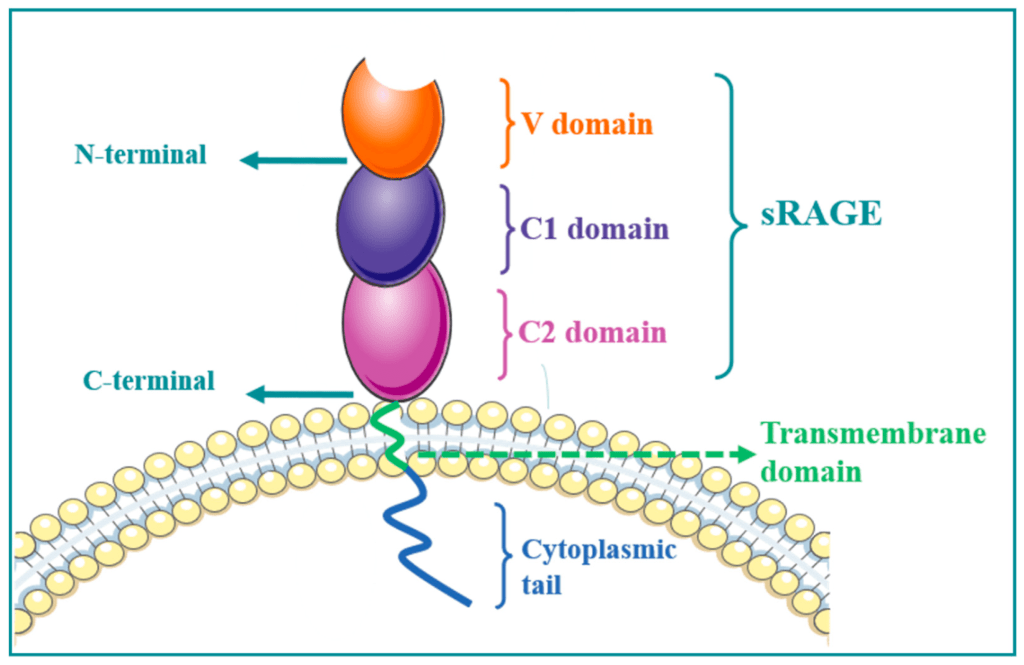
All three segments work together to initiate different signaling pathways that eventually result in oxidative stress response, inflammation, and apoptosis, which were highlighted on the previous post.
Ligands
Ligands bind to RAGE in the extracellular segment of the protein, where the ligand-binding site is located. Unlike other types of receptors, RAGE is not selective to only one ligand. RAGE is considered the primary receptor for AGEs, but it is not the only thing that this receptor binds to. RAGE also has affinity towards other molecules and proteins such as:
- Advanced Glycation End Products (AGEs)
- High-Mobility Group Protein 1 (HMGB1)
- Members of the S100 Protein Family (S100)
- Amyloid β (Aβ) peptide
- Type I and Type IV Collagen
- Prions, Bacteria, and Lymphocytes
The RAGE is known to bind to a variety of ligands, which play a crucial role in initiating intracellular signaling cascades and mediating various physiological and pathological processes.
Essentially, the ability of RAGE to bind such a diverse array of ligands underscores its versatility as a receptor that can potentially be involved in multiple biological functions and disease processes. Studying the interactions between RAGE and its ligands provides valuable insights into the mechanisms underlying RAGE-mediated pathophysiology and offers potential avenues for therapeutic intervention in various disorders.
Because of my current interest in neurodegenerative processes and diseases, Amyloid Beta (Aβ) peptide is the ligand of RAGE that I find most interesting and want to further study.
Inflammatory Response
When RAGE binds a ligand, such as those already mentioned, it initiates a series of intracellular signaling events. This binding activates downstream signaling pathways, including the Mitogen-Activated Protein Kinase (MAPK) and Nuclear Factor kappa B (NF-κB) pathways, leading to the transcription of proinflammatory cytokines and other inflammatory mediators.
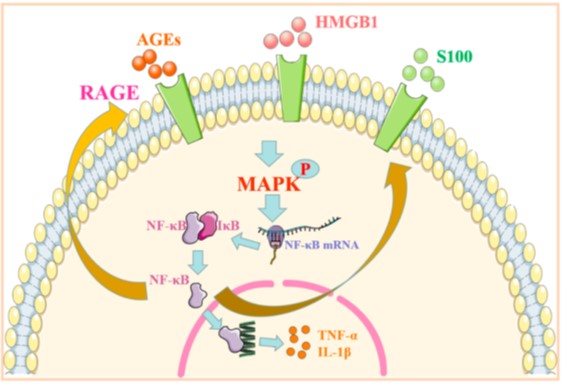
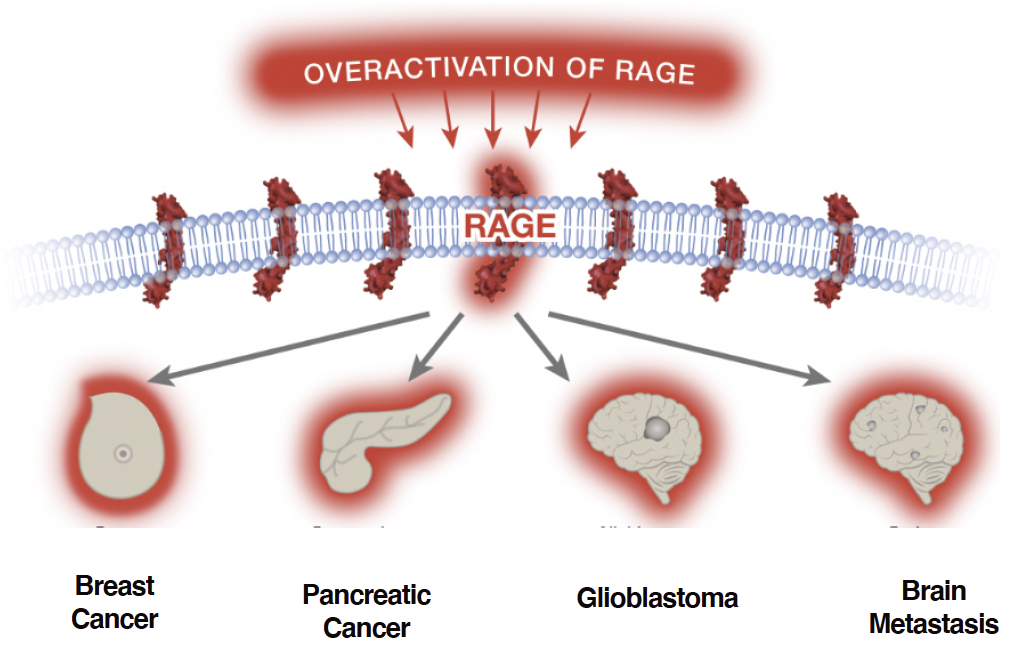
Ultimately, the binding of ligands to the transmembrane RAGE triggers a cascade of intracellular events that culminate in the promotion of inflammation and immune response, highlighting the role of RAGE in mediating inflammatory processes and disease progression. These ligands bind to RAGE and trigger downstream signaling pathways, leading to inflammatory responses, oxidative stress, and tissue damage in various pathological conditions.
Summary
Hello again! Thank you for taking the time to read this article. I hope that you have learned something new and enjoyed this quick read. In this post, I introduced the Receptor for Advanced Glycation End Products (RAGE), its structure, some of its ligands, and the intracellular cascade that results in inflammatory response, oxidative stress, and tissue damage.
The complexity of this receptor and the downstream effects that its activation has on the cells and body are extremely fascinating and should be further investigated. I believe this post may have been more challenging for readers who are not very familiar with specific concepts about cell biology. If you should take away at least one thing from this post, it should be the following
- Transmembrane RAGE is a receptor (located in cell membranes) that binds to the AGEs. This binding that occurs extracellularly results in an activation of pathways and intracellular signaling events that eventually lead to inflammatory response, oxidative stress inside the cell and tissue damage.
- AGEs bind to RAGE and result in inflammation and oxidative stress that, if prolonged, may damage tissues. Also important:
- Also important to keep in mind that this same receptor may have the same intracellular response when binding to other ligands that are not AGEs.
References
Twarda-Clapa A, Olczak A, Białkowska AM, Koziołkiewicz M. Advanced Glycation End-Products (AGEs): Formation, Chemistry, Classification, Receptors, and Diseases Related to AGEs. Cells. 2022 Apr 12;11(8):1312. doi: 10.3390/cells11081312. PMID: 35455991; PMCID: PMC9029922.
Yue Q, Song Y, Liu Z, Zhang L, Yang L, Li J. Receptor for Advanced Glycation End Products (RAGE): A Pivotal Hub in Immune Diseases. Molecules. 2022 Aug 2;27(15):4922. doi: 10.3390/molecules27154922. PMID: 35956875; PMCID: PMC9370360.
Yan SD, Bierhaus A, Nawroth PP, Stern DM. RAGE and Alzheimer’s disease: a progression factor for amyloid-beta-induced cellular perturbation? J Alzheimers Dis. 2009;16(4):833-43. doi: 10.3233/JAD-2009-1030. PMID: 19387116; PMCID: PMC3726270.
Image credits:
- Cover Image: https://cdn1.sinobiological.com/styles/default/images/protein-structure/AGER-protein-structure.jpg
- RAGE molecule structure: https://www.mdpi.com/molecules/molecules-27-04922/article_deploy/html/images/molecules-27-04922-g001-550.jpg
- RAGE regulation of NF-kB: https://www.mdpi.com/molecules/molecules-27-04922/article_deploy/html/images/molecules-27-04922-g002-550.jpg
- Overaction of Rage: https://cantex.com/wp-content/uploads/2023/01/0veractivation.png
I would really appreciate your feedback on this post to see if I was still able to be effective in explaining these concepts that are a bit more challenging to understand, even for me. Based on your feedback to this entry, I will decide what to focus on for the next entry. Leave a comment, share with your friends, colleagues, or family, and most importantly, stay tuned for the next post! Thanks!
 Arbona Health Hub


[…] Hello! Welcome back to the AGEs series. This is the third entry for this series, where we focus on understanding what are Advanced Glycation End Products (AGEs) and discuss novel research findings on this topic. If you have missed our past two entries or would like to refresh your memory on the topic, I suggest you go back and read these articles, which I will link here (Entry 1) (Entry 2). […]
LikeLike