Approaching one of the most commercially exploited days of our generation, Valentine’s Day, we find a dedicated team leveraging our neurochemistry’s significant role in this celebration. Beyond the commercial aspect of Valentine’s Day lies a fascinating interplay within our bodies, where reactions can be, at times, unpredictable. These responses stem from the profound emotions of love and affection cultivated through shared remarkable experiences with those around us—be it a partner, friend, or family member. Today, we delve into the intricate world of neurochemistry to unravel the scientific underpinnings of the emotions that play a crucial role in our relationships.
Introduction
Love, a profound and intricate emotion, significantly shapes our lives. Recent research published in Biology 2023 unravels the neurochemistry of love and pair bonding, providing insights into the biological mechanisms that govern our romantic connections. In this article, we aim to simplify the study’s key findings, making the captivating science behind love accessible and understandable to all.
The Neurobiology of Love
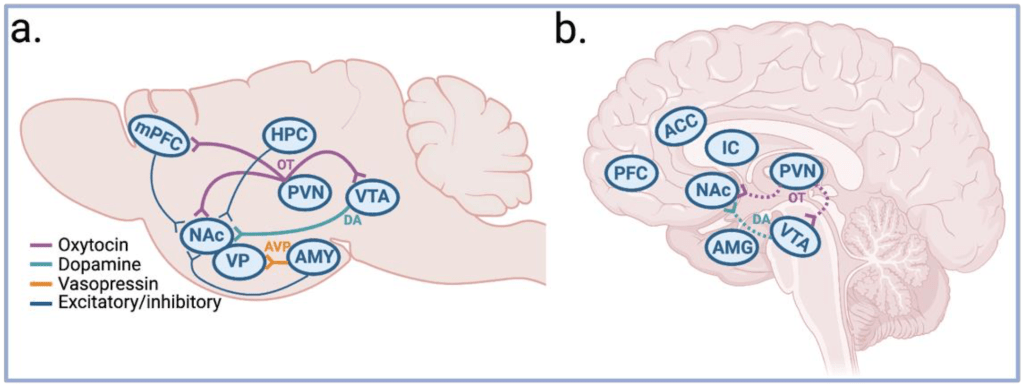
In the study conducted by Blumenthal and Young (2023), which explores the neurobiological basis of love and pair bonding from both human and animal perspectives, essential neurotransmitters come into play. Oxytocin, serotonin, and dopamine, often dubbed the “love trio,” play crucial roles in fostering feelings of attachment, trust, and pleasure in relationships. Oxytocin, known as the “love hormone,” is particularly noteworthy for its involvement in bonding and social connection. Released during intimate moments like hugging, cuddling, and sexual activity, it fosters feelings of attachment and trust in relationships. These intimate interactions contribute to the release of dopamine, the “pleasure neurotransmitter,” reinforcing positive behaviors and creating a sense of euphoria, thus enhancing the pleasure derived from romantic relationships.
Figure 1: Brain regions that play a role in the pathway. The ventral tegmental area (VTA) coordinates reward processing, the amygdala oversees emotional responses, and the nucleus accumbens floods the brain with dopamine, contributing to the experience of pleasure and reinforcement.
Impact of Separation
The study also addresses the impact of separation on individuals in romantic relationships, examining the behaviors and physiological changes associated with it. In instances of separation, the balance of neurotransmitters such as serotonin and dopamine is crucial. Imbalances can lead to sadness, depression symptoms, and increased feelings of longing and heartache. These emotional challenges underscore the intricate interplay of neurotransmitters in maintaining emotional well-being.
The Healing Power of Love
Moving beyond the neurochemistry of love, we explore the long-term health benefits of committed partnerships. Married individuals, for instance, exhibit a lower likelihood of succumbing to cancer or heart failure, attributed in part to the support and care provided by their partners. Recognizing the essential role of neurotransmitters like serotonin and dopamine in regulating mood and pleasure, respectively, emphasizes the importance of nurturing healthy relationships for overall well-being.
Figure 2: This diagram illustrates how dopamine, serotonin, and norepinephrine play important roles in various activities. This visual will show not only their individual functions but also how they work together, interacting to influence our experiences.
Conclusion
Understanding the neurochemistry of love sheds light on the biological mechanisms behind our emotional connections, particularly relevant on occasions like Valentine’s Day. Oxytocin, serotonin, and dopamine are key neurotransmitters involved in fostering feelings of attachment, trust, and pleasure in relationships. Recognizing these biological underpinnings underscores the importance of nurturing healthy relationships for overall well-being. By appreciating the role of neurotransmitters in love, we can cultivate deeper emotional connections and foster lasting happiness in our relationships, not just on Valentine’s Day but every day.
Take-Home Message As we explore the intricate neurochemistry of love and bonding, it becomes clear that the stages of forming lasting connections are not limited to humans alone. Figure 3 in the research study vividly illustrates the progression from initial attraction to the establishment of enduring bonds, providing a visual roadmap to the complex neural mechanisms underlying relationships. Through a comparative analysis of research methods employed in both rodents and humans, we uncover parallels and distinctions in the neurobiological processes that govern love and pair bonding. This cross-species exploration not only enhances our understanding of the evolutionary foundations of these emotions but also emphasizes the universality of the neural processes that shape and nurture connections in relationships.
Blumenthal, S. A., & Young, L. J. (2023). The Neurobiology of Love and Pair Bonding from Human and Animal Perspectives. Biology, 12(6), 844. https://doi.org/10.3390/biology12060844





 Arbona Health Hub
Thanks Héctor! Really enjoyed reading about this today.
LikeLike