

Hello! Thank you for visiting. In my next series of posts, I will focus on summarizing a concept that I find very fascinating: advanced glycation end products (AGEs). I have dedicated my time to researching and learning more about this specific subject, and I would love the opportunity to share some of the knowledge I have acquired and engage in discussions with you. While I am not yet an expert in this matter, I certainly intend to become one soon. I will attempt to create a series of continued posts about AGEs to better simplify and expound upon these compounds that I find so remarkable. I have titled this series, “The Sweet Science: Unraveling the Impact of Advanced Glycation End Products on Your Health.”

Introducing AGEs:
What are AGEs?
- Advanced glycation end products (AGEs) are a family of potentially harmful and heterogenous compounds that result from nonenzymatic reactions between reducing sugars and proteins, lipids, or nucleic acids.
- AGEs are considered potentially harmful produced in higher instances, and their presence has been noted in many health conditions and chronic diseases, including Cardiovascular Disease (CVD) and diabetes, as well as cancer, neurodegenerative diseases, and many other illnesses.
- AGEs have been shown to promote oxidative stress, inflammation, and apoptosis through multiple mechanisms and pathways that you will read about in this series.
As I continue to delve into these end products, I become increasingly interested in understanding the extent to which these compounds may be involved in the many pathophysiological processes and diseases that remain largely understudied and mysterious for the research and health community.
Why should we know about AGEs?
Because the formation of these products requires reducing sugars, understanding these compounds and their effects on the body is of particular interest to me, especially when considering the dietary pattern of the modern Western diet. This diet involves high intakes of pre-packaged foods, refined grains, red meat, processed meat, high-sugar drinks, candy, sweets, fried foods, conventionally raised animal products, high-fat dairy products, and high-fructose products.
- The availability of sugar is directly correlated with the incidence of AGE formation. This means that if sugars are present at a higher concentration, and if conditions are present, they will want to react with residues and eventually form these end products.
How are AGEs formed?
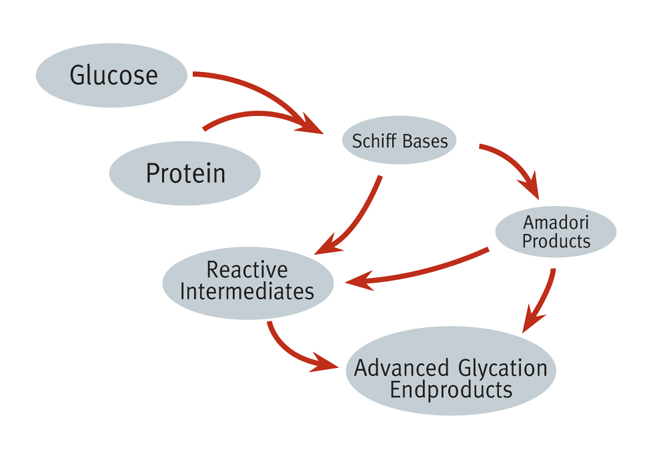
- In more detail, AGEs result from a non-enzymatic condensation reaction between carbonyl groups of reducing sugars and free amine groups of nucleic acids, proteins, or lipids, followed by further rearrangements to yield a stable end product.
- During this complex reaction, which includes and can progress via several different pathways, glycation occurs, where a sugar molecule covalently attaches to a residue in a protein, lipid, or nucleic acid without the need for an enzyme or catalyst.
- This bonding can occur to amino acid residues in proteins that may be more susceptible to reacting with a reducing sugar molecule, such as the side chains of lysine and arginine that have a positive charge and are basic.
- The process happens when conditions are favorable and may occur both inside the body (endogenous AGEs) and outside (exogenous AGEs).
- Some exogenous AGEs are formed during the cooking or processing of foods at high temperatures, particularly through methods such as grilling, frying, or roasting. One important reaction for the formation of this product was discovered in 1912 by a French physician and chemist named Louis Camille Maillard as he investigated the browning seen in the process of baking and broiling in the reaction of glucose with glycine.
- You will read more about this in the next post of this series.
Classifying AGEs:
AGEs are heterogenous compounds that posses distinct properties. As new discoveries have surfaced, they have been classified into different categories to help us understand their diversity and different roles in all the physiological and pathological processes in which they are involved.
Classification also helps to identify the specific AGEs that may be associated with different diseases and to develop targeted therapies for these diseases. Furthermore, the classification of AGEs can aid in the development of biomarkers for the diagnosis and monitoring of AGE-related diseases. Below are some of the most common classification for AGEs, which I believe will be essential for you to know about to better understand the future posts.
- Source
- Endogenous
- Exogenous (dietary, dAGEs)
- Molecular Weight
- Low Molecular Weight (LMW)
- High Molecular Weight (HMW)
- Chemical Structure and Ability to Emit Fluorescence
- Fluorescent and crosslinked (LMW AGEs)
- Fluorescent and non-crosslinked (TAGEs)
- Non-fluorescent and crosslinked (HMW AGEs)
- Non-fluorescent and non-crosslinked
- Precursor
- Glucose-derived (Glu-AGEs)
- Fructose-derived (Fru-AGEs)
- Glycolaldehyde-derived (Glycol-AGEs)
- Glyceraldehyde-derived (Glycer-AGEs)
- Methylglyoxal-derived (MGO-AGEs)
- Glyoxal-derived (GO-AGEs)
- 3-Deoxyglucosone-derived (3-DG-AGEs)
- Physiological Importance
- Non-toxic
- Toxic
Summary of this post
Hello, again! Thank you for taking from the time to read this article. I hope that you have learned something new and enjoyed this quick read. In this post I tried to briefly explain what an AGE is, how they form, some of the differences between them, why they are different, and why I find them so exciting to learn about.
In my next post, I will go into more detail about how AGEs promote oxidative stress, inflammation and apoptosis. Also, I will introduce my current favorite receptor, the Receptor for Advanced Glycation End Products (RAGE). Please tell me what you think about this post, if you liked it, if you learned anything new, and if you have any questions or suggestions. Leave a comment, share with your friends, colleagues, or family, and most importantly, stay tuned for the next post! Thanks!
References
Twarda-Clapa A, Olczak A, Białkowska AM, Koziołkiewicz M. Advanced Glycation End-Products (AGEs): Formation, Chemistry, Classification, Receptors, and Diseases Related to AGEs. Cells. 2022 Apr 12;11(8):1312. doi: 10.3390/cells11081312. PMID: 35455991; PMCID: PMC9029922.
Reducing sugar. Reducing Sugar – an overview | ScienceDirect Topics. (n.d.). https://www.sciencedirect.com/topics/biochemistry-genetics-and-molecular-biology/reducing-sugar
Accumulation of ages. Diagnoptics. (2018, May 8). https://www.diagnoptics.com/advanced-glycation-endproducts/accumulation-of-ages/
Tags: AGE, AGEs, Advanced Glycation End Products, Metabolism, Nutrition, Education
 Arbona Health Hub
Hi Marcel! I find really interesting your topic of choice, it intrigues me how you first came across it. I’ll definitely keep posted with your series, due to its apparent relevance in our everyday habits throughout our diet. Furthermore, I’m specifically interested in how it applies is neurodegenerative diseases. Quick read, easy to read… amazing! 🙂
LikeLiked by 1 person
Hola Marcel
Me gustaría que identificaras por su nombre común esos componentes y a los alimentos que en su elaboración, les añaden los mismos.
LikeLike
[…] your memory on the topic, I suggest you go back and read these articles, which I will link here (Entry 1) (Entry […]
LikeLike
Just saw the title of the third article and realized there was a whole story about this. In my time in medical school, AGEs has been a very intriguing topic for me because of its mechanism of damage and how you mention that it is available for us to consume. Nevertheless, they don’t get into the “nitty-gritty”, only basic stuff and how to treat it. I’m glad an old college of mine is working on this! I look forward to keep learning on this series.
LikeLike