

Summary
Phototransduction is a light-stimulated process that heavily relies on continuous regeneration of 11-cis-retinal to keep rhodopsin function and adequate visual performance. Vitamin A is essential in this process, serving as a precursor of 11-cis-retinal. However, it is not naturally produced by the human body. A deficiency of this vitamin disrupts phototransduction and can lead to adverse symptoms, such as night blindness. This review explores the downstream consequences of impaired rhodopsin regeneration in vitamin A deficiency (VAD), focusing on photoreceptor structural and functional health. Studies reviewed examined the role of Vitamin A in the visual system and how a reduction in rhodopsin can lead to degeneration of photoreceptor outer segments, opsin mislocalization, and eventual photoreceptor death. Ultimately, the evidence reinforces that vitamin A is crucial in sustaining retinal health, preserving photoreceptor integrity, and preventing vision loss.
Introduction
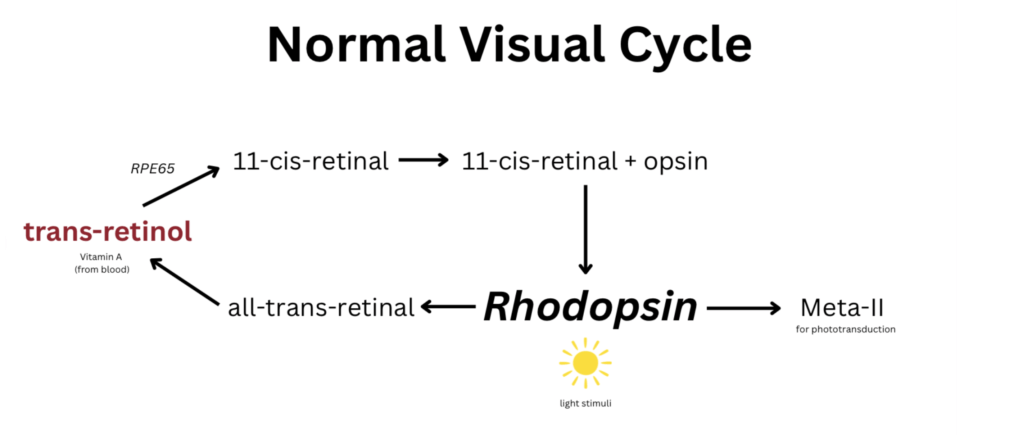
Phototransduction is the process by which light is converted into electrical impulses and ultimately processed by the brain. An important part of this process is that of the conversion of 11-cis-retinal into all-trans-retinal upon rhodopsin’s absorption of light (Dewett et al., 2021). This photoisomerization converts rhodopsin into its active form, metarhodopsin II (Meta-II), which initiates phototransduction. After serving its function, activated rhodopsin dissociates into retinal and opsin. For phototransduction to continue occurring normally, 11-cis-retinal must be regenerated, as shown in Figure 1.
Vitamin A is a precursor of 11-cis-retinal, and is not synthesized endogenously, which is why it is crucial to acquire it from the diet (Dewett et al., 2021). While there is extensive knowledge about the initial rhodopsin decrease following VAD, this review focuses on examining the downstream effects on photoreceptor health specifically related to the impairment of rhodopsin regeneration.
This brief literature-based review article synthesizes findings of multiple studies that help answer the question of what the downstream effect of rhodopsin impairment on photoreceptors is. Selected sources include a human case report, rodent and Drosophila model studies that examine phototransduction function, rhodopsin levels, and photoreceptor structure under VAD conditions.
Findings
The first study reviewed investigates the effect of vitamin A deficiency (VAD) in rat retinas, both structurally and biochemically. Carter-Dawson et al. (1979) showed that, by the ninth week of deficiency, retinas lacking sufficient vitamin A displayed only 20% of control rhodopsin levels. This reduction not only impaired the phototransduction process but also led to photoreceptor cell death by week 16, specifically the distal third outer segment of rods. This degeneration was attributed to the instability of outer segment discs caused by insufficient rhodopsin. These findings suggest that VAD not only disrupts 11-cis-retinal regeneration but also that this deficiency can rapidly progress from biochemical disruptions to structural, irreversible degeneration within weeks.
Carter-Dawson et al.’s (1979) findings were confirmed over four decades later by Jevnikar et al. (2022) reinforcing the consistency of results across time and methodology. Jevnikar et al. (2022) reported a case where an elderly patient presented with worsening nyctalopia due to a deficiency in vitamin A. Once an optical coherence tomography was performed, it revealed rod outer segment degeneration; rod function had also been noted to decrease after two months of symptom onset, followed by a dysfunction in cones after eight months. Remarkably, normal retinal structure was observed after adequate supplementation of vitamin A, confirming reversibility of symptoms and damage is possible if treated urgently.
At a molecular level, Kumar et al. (2022) reported that VAD directly impacts phototransduction machinery, particularly proteins involved in the amplification of a visual signal. Since amplification is crucial in a photoreceptor’s response to light stimuli, disruption in machinery significantly compromises their function. Thus, VAD weakens vision not only by reducing rhodopsin levels, but also by preventing proper signal transduction.
Extending these findings, Ramkumar et al. (2021) further demonstrated that chronic vitamin A deficiency disturbs the balance between opsin and 11-cis-retinal, leading to opsin mislocalization and consequential photoreceptor dysfunction. Unbound opsin accumulates due to the reduction of 11-cis-retinal formation in VAD, exacerbating photoreceptor stress and death.
Altogether, these findings, reinforced by Sajovic et al. (2022), show that VAD initiates a detrimental cascade, beginning with impaired rhodopsin regeneration and ultimately resulting in widespread photoreceptor dysfunction and permanent degeneration.
Discussion
Chronic vitamin A deficiency (VAD) has consistently been shown to affect photoreceptor structure and function in several ways. VAD impairs rhodopsin regeneration in the process of phototransduction, but this only represents the initial step in a deeper, complex cascade. Studies demonstrate how reduced rhodopsin levels lead to disruption of pathways essential for photoreceptor survival and function; its deficiency may lead to degeneration of photoreceptors’ outer segments. In addition, VAD creates an imbalance between chromophore and opsin, caused by the inability to regenerate chromophores, which severely affects electrical responses of photoreceptors to light stimuli, further contributing to their functional impairment. Over time, prolonged deficiency can lead to permanent photoreceptordegeneration and consequential visual impairment (Sajovic et al., 2022).
It is crucial to note that studies examined in this review did not include humans, which means further research must be done on this topic.
Conclusion
To directly answer the question initially posed: structurally, VAD’s effect on rhodopsin leads to outer segment degeneration and opsin mislocalization while in terms of survival, it causes photoreceptor dysfunction, degeneration, and eventually, death.
References
- Dewett, D., Lam-Kamath, K., Poupault, C., Khurana, H., & Rister, J. (2021). Mechanisms of vitamin A metabolism and deficiency in the mammalian and fly visual system. Developmental Biology, 476, 68-78. https://doi.org/10.1016/j.ydbio.2021.03.013
- Carter-Dawson, L., Kuwabara, T., O’Brien, P.J. & Bieri, J.G. Structural and biochemical changes in vitamin A–deficient rat retinas. (1979). PubMed. https://pubmed.ncbi.nlm.nih.gov/437947/
- Jevnikar, K., Šuštar, M., Kozjek, N. R., Štrucl, A. M., Markelj, Š., Hawlina, M., & Fakin, A. (2022). Disruption of the outer segments of the photoreceptors on optical coherence tomography as a feature of vitamin A deficiency. Retinal Cases & Brief Reports, 16(5), 658–662. https://doi.org/10.1097/icb.0000000000001060
- Kumar, M., Has, C., Lam-Kamath, K., Ayciriex, S., Dewett, D., Bashir, M., Poupault, C., Schuhmann, K., Knittelfelder, O., Raghuraman, B. K., Ahrends, R., Rister, J., & Shevchenko, A. (2022). Vitamin A deficiency alters the phototransduction machinery and distinct Non-Vision-Specific pathways in the drosophila eye proteome. Biomolecules, 12(8), 1083. https://doi.org/10.3390/biom12081083
- Ramkumar, S., Parmar, V. M., Samuels, I., Berger, N. A., Jastrzebska, B., & V on Lintig, J. (2021). The vitamin A transporter STRA6 adjusts the stoichiometry of chromophore andopsins in visual pigment synthesis and recycling. Human Molecular Genetics, 31(4), 548–560. https://doi.org/10.1093/hmg/ddab267
- Sajovic, J., Meglič, A., Glavač, D., Markelj, Š., Hawlina, M., & Fakin, A. (2022). The role of vitamin A in retinal diseases. International Journal of Molecular Sciences, 23(3), 1014. https://doi.org/10.3390/ijms23031014
 Arbona Health Hub