
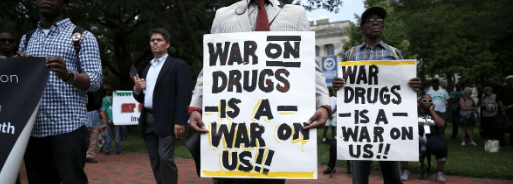

For decades, the so-called “War on Drugs” has been driven by punitive policies that not only fail to protect society but have also led to devastating public health consequences and entrenched racial and social inequalities. Drawing on insights from voices such as Dr. Carmen Albizu García and supported by a growing body in interdisciplinary research, this article argues for a fundamental rethinking of drug policy. By moving from criminalization toward a decriminalization and regulated legalization, we can foster an approach grounded in public health and racial justice that prioritizes treatment, harm reduction, and community well-being over punishment (Earp et al., 2021).
Historical Context of Punitive Drug Policy
The roots of punitive drug policy can be traced back to the early 1970s when President Richard Nixon’s declaration of ‘War on Drugs” served not only as a political maneuver against opposition but also to target minority communities (Cummings & Ramirez, 2021). While marijuana (cannabis) was Nixon’s oft-cited focus, portrayed as the plague of young antiwar protesters, his campaign also laid groundwork for crackdowns on hard drugs such as heroin and cocaine, treating all these substances as criminal problems rather than health issues (Sirin, 2011). Nixon’s targeted antiwar protesters and minority communities, using drug laws as pretext to discredit opposition. This period laid the foundation for a punitive system by linking drug use with political subversion and racial deviance (Cummings & Ramirez, 2021).

The approach intensified under President Ronald Reagan in the 1980s. Reagan expanded harsh sentencing guidelines and increased funding for drug enforcement. His policies not only reinforced the punitive measures initiated under Nixon but also amplified the racial disparities inherent in drug law enforcement. These policies boost mandatory minimums for cocaine; especially crack, Reagan’s tougher sentencing guideline contributed to roughly a 400 % increase in the U.S. incarceration rate growing from about 200,000 people behind bars in 1970 to nearly two million by 2000 (Vera Institute of Justice, n.d.; Ziedenberg & Schiraldi,1999). Altogether these policies contributed to disproportionately penalize Black communities (Palamar et al., 2015; Sirin, 2011).
Shifting Public Perceptions and Policy Reforms
In recent decades, evolving public sentiment and emerging evidence of the collateral harms of strict enforcement have encouraged new reforms. Measures such as decriminalization in select jurisdictions and a reduction in mandatory minimum sentences reflect a growing consensus: drug use should be approached as a public health issue rather than solely a criminal matter (Smith, 2021; Gottschalk, 2023).
The negative consequences of a punitive approach are far reaching. Criminalization discourages individuals from seeking treatment or harm reduction services, exacerbating public health challenges such as the opioid crisis (Tyndall & Dodd, 2020). Moreover, repeated enforcement actions regardless of similar usage rates across racial groups have entrenched systemic disparities, leading to long-term economic and social exclusion. Research shows that the legacy of punitive policies continues to bias substance use studies, impeding evidence-based public health strategies (Stone, 2024).

Impact on Public Health and Racial Justice
The enforcement driven approach to drug policy has produced widespread negative consequences and serious public health implications. Criminalization discourages individuals from seeking necessary health services and harm reductions support (Tyndall & Dodd, 2020). Structural violence and stigma, intensified by punitive policies, have paralyzed effective responses to the opioid crisis in North America and Puerto Rico (Santiago-Negrón & Albizu-García, 2003; Tyndall & Dodd, 2020). Substance use research is skewed by the legacy of the war on Drugs, ultimately impeding the development of evidence-based public health strategies (Stone, 2024).
Despite similar rates of drug use across racial groups, enforcement practices have disproportionately impacted people of color (Earp et al., 2021; Cummings & Ramirez,2021). The currents drug policy framework reinforces systemic prejudice and discrimination through higher arrest, convictions, and incarceration rates among Black and Hispanic. These disparities contribute to long-term economic and social exclusion, perpetuating cycles of poverty and limited opportunities (Earp et al., 2021; Cummings & Ramirez, 2021).
The collateral consequences of these policies extend far beyond individual health (Santiago-Negrón & Albizu-García, 2003). The punitive approach has contributed to the formation of a “prison-industrial complex,” where the economic incentives of mass incarceration further marginalize vulnerable population. The focus on punishment has undermined public health efforts and deepened social inequities (Santiago-Negrón & Albizu-García, 2003).

Proposals for a Public Health-Based Approach
The first step is to decriminalize the possession and use of small amounts of non-medical drugs. Removing criminal penalties for small amounts of key substances: cannabis, MDMA, cocaine, heroin and methamphetamine would allow individuals to seek help without fear of arrest, thereby facilitating access to treatment and harm reduction services. Evidence from countries like Portugal shows that decriminalization can lead to significant improvements in public health outcomes (Csete et al., 2016). Portugal’s 2001 reform reclassified personal possession of all drugs as an administrative, not criminal, offense. Decisions are made by local “dissuasion commissions” that include health and legal professionals, who can refer individuals directly into counseling or treatment instead of jail. Savings from reduced prosecutions were then funneled into community-based services, resulting in a 60 % increase in treatment uptake and an 80 % drop in HIV incidence among people who inject drugs within five years (Greenwald, 2009; Hughes & Stevens, 2010).
Decriminalization should be followed by comprehensive legal regulation. By establishing a framework similar to alcohol and tobacco controls: license the cultivation and sale of cannabis, pilot prescription of heroin in supervised settings as in Switzerland and offer drug-checking for MDMA or cocaine to guard against adulterant like fentanyl (Hughes & Stevens, 2010; Westenberg et al., 2023). Standards for production, distribution, and sale, regulation can ensure product safety, reduce the harms associated with adulterated drugs, and generate tax revenue to be reinvested in public health programs (Maghsoudi et al., 2022). Resources saved from reducing incarceration rates should be redirected toward expanding addiction treatment, preventive education, and community-based support programs. Such reinvestment would address the underlying social determinants of drug abuse, fostering long-term improvements in public health and social equity (Gottschalk, 2023). A critical component of reform is reorienting police practices to prioritizing health interventions over punitive measures can further reduce the collateral harms inflicted on marginalized communities (Christine, 2021; Earp et al., 2021).

Looking Ahead
Empirical evidence and personal testimonies alike reveal that the current punitive model not only fails to prevent drug use but also magnifies health risk, social inequities and illustrate the human cost of criminalization, families disrupted, lives altered by criminal records, and communities left without support. A comprehensive shift toward a public health centered strategy is essential for reducing overdose deaths, curbing the spread of infectious diseases, and repairing communities that have long endured the burden of harsh drug policies. (Cummings & Ramirez, 2021; Santiago-Negrón and Albizu-García, 2003).
Conclusion: From Punishment to Public Health
Decades of punitive drug policies in the U.S. and Puerto Rico have deepened racial and social injustices, exacerbated public health crises, and failed to reduce drug use. Communities of color, particularly Black and Latino populations, have endured the burden of mass incarceration and aggressive policing, despite similar rates of drug use across racial groups. Meanwhile, overdose deaths have skyrocketed, and access to treatment remains limited, especially in marginalized communities.
The evidence is clear: criminalization worsens outcomes, while public health strategies save lives. Harm-reduction programs like syringe exchanges, naloxone distribution, and medication-assisted treatment are proven to reduce disease transmission, overdose deaths, and drug dependency. Yet, outdated laws and misplaced funding priorities continue to block widespread adoption.
A real shift is urgently needed. Decriminalizing personal drug use, investing in treatment and community services, and ending discriminatory enforcement practices are essential steps. Without bold action, the devastating human toll rising overdose deaths, mass incarceration, and deepening inequalities will only grow, leaving already vulnerable communities to suffer even greater consequences.
The choice is stark: continue a cycle of punishment and loss, or invest in evidence-based, compassionate solutions that promote health and justice. The path forward is clear—and the cost of inaction is too high to ignore.
References
Earp, B. D., Lewis, J., Hart, C. L., & with Bioethicists and Allied Professionals for Drug Policy Reform (2021). Racial Justice Requires Ending the War on Drugs. The American journal of bioethics : AJOB, 21(4), 4–19. https://doi.org/10.1080/15265161.2020.1861364
Cummings, A. D. P., & Ramirez, S. A. (2021). The racist roots of the war on drugs & the myth of equal protection for people of color. UALR L. Rev., 44, 453. https://lawrepository.ualr.edu/lawreview/vol44/iss4/1
Sirin, C. V. (2011). From Nixon’s War on Drugs to Obama’s drug policies today: Presidential progress in addressing racial injustices and disparities. Race, Gender & Class, 82-99.
Ziedenberg, J., & Schiraldi, V. (1999). The punishing decade: Prison and jail estimates at the millennium (p. 4). Washington, DC: Justice Policy Institute.
Vera Institute of Justice. (n.d.). Causes of mass incarceration. Vera Institute of Justice. https://www.vera.org/ending-mass-incarceration/causes-of-mass-incarceration?utm_source=chatgpt.com
Palamar, J. J., Davies, S., Ompad, D. C., Cleland, C. M., & Weitzman, M. (2015). Powder cocaine and crack use in the United States: an examination of risk for arrest and socioeconomic disparities in use. Drug and alcohol dependence, 149, 108–116. https://doi.org/10.1016/j.drugalcdep.2015.01.029
Smith, B. T. (2021). New Documents Reveal the origins of America’s war on drugs. Times. https://time.com/6090016/us-war-on-drugs-origins/
Santiago-Negrón, S., & Albizu-García, C. E. (2003). Guerra contra las Drogas o Guerra contra la Salud? Los retos para la salud pública de la política de Drogas de Puerto Rico [War on Drugs or War against Health? The pitfalls for public health of Puerto Rican drug policy]. Puerto Rico health sciences journal, 22(1), 49–59.
Gottschalk, M. (2023). The opioid crisis: the war on drugs is over. Long live the war on drugs. Annual review of criminology, 6(1), 363-398. http://dx.doi.org/10.1146/annurev-criminol-030421-040140
Tyndall, M., & Dodd, Z. (2020). How Structural Violence, Prohibition, and Stigma Have Paralyzed North American Responses to Opioid Overdose. AMA journal of ethics, 22(1), E723–E728. https://doi.org/10.1001/amajethics.2020.723
Stone B. M. (2024). The War on Drugs has Unduly Biased Substance Use Research. Psychological reports, 127(4), 2087–2094. https://doi.org/10.1177/00332941221146701
Color of Pain. (n.d.). Criminal Justice – The Drug Policy Alliance. http://www.colorofpain.org/criminal-justice
Csete, J., Kamarulzaman, A., Kazatchkine, M., Altice, F., Balicki, M., Buxton, J., Cepeda, J., Comfort, M., Goosby, E., Goulão, J., Hart, C., Kerr, T., Lajous, A. M., Lewis, S., Martin, N., Mejía, D., Camacho, A., Mathieson, D., Obot, I., Ogunrombi, A., … Beyrer, C. (2016). Public health and international drug policy. Lancet (London, England), 387(10026), 1427–1480. https://doi.org/10.1016/S0140-6736(16)00619-X
Greenwald, G. (2009). Drug decriminalization in Portugal: Lessons for creating fair and successful drug policies. Cato Institute. https://www.hanfplantage.de/images/greenwald_whitepaper.pdf
Hughes, C. E., & Stevens, A. (2010). What can we learn from the Portuguese decriminalization of illicit drugs?. The British Journal of Criminology, 50(6), 999-1022.
Westenberg, J. N., Meyer, M., Strasser, J., Krausz, M., Dürsteler, K. M., Falcato, L., & Vogel, M. (2023). Feasibility, safety, and acceptability of intranasal heroin-assisted treatment in Switzerland: protocol for a prospective multicentre observational cohort study. Addiction science & clinical practice, 18(1), 15. https://doi.org/10.1186/s13722-023-00367-0
Maghsoudi, N., Tanguay, J., Scarfone, K., Rammohan, I., Ziegler, C., Werb, D., & Scheim, A. I. (2022). Drug checking services for people who use drugs: a systematic review. Addiction (Abingdon, England), 117(3), 532–544. https://doi.org/10.1111/add.15734
Christine, J. (2021). Facts and Recommendations: How Cannabis legalization can be used to repair the damage to communities worst affected by the US War on Drugs. [Report]. https://hdl.handle.net/1813/111103
 Arbona Health Hub